

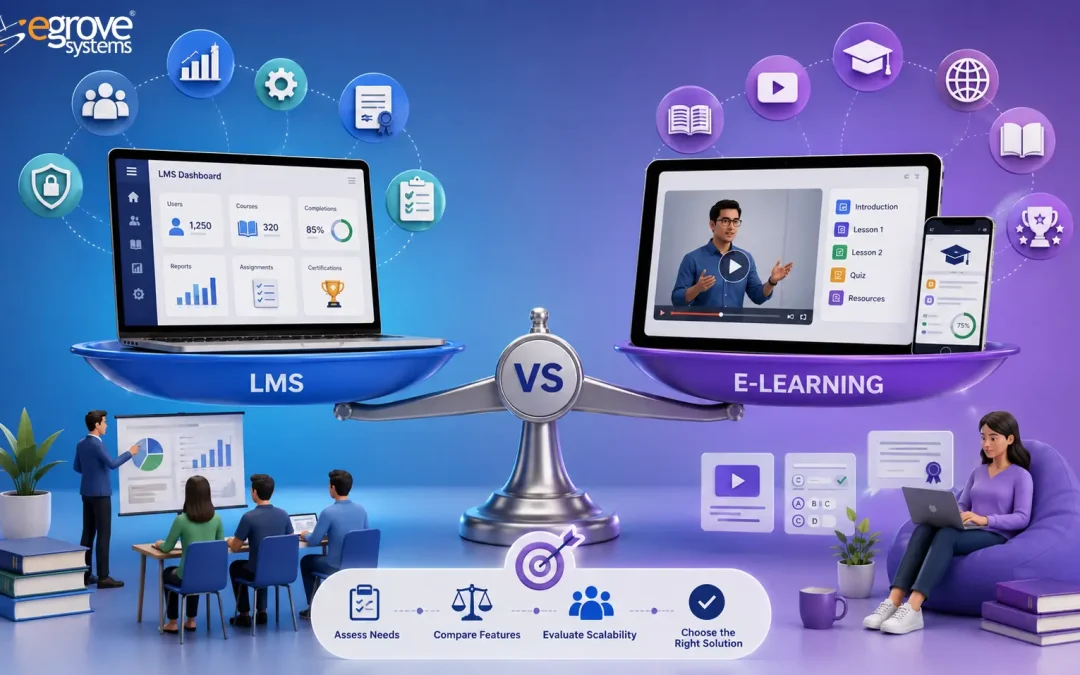
Digital learning has transformed the way organizations train employees, onboard new hires, ensure compliance, and develop workforce skills. As remote work, hybrid workplaces, and continuous learning become the norm, businesses are increasingly investing in e-learning technologies to build knowledgeable and future-ready teams.
However, one question continues to create confusion among decision-makers:
Is an E-learning platform the same as a Learning Management System (LMS)?
While these terms are often used interchangeably, they are not identical. Understanding the difference helps organizations select the right technology based on their learning objectives, compliance requirements, and business goals.
In this blog, we’ll explore the differences between e-learning platforms and Learning Management Systems (LMS), compare their features, examine their ideal use cases, and explain how organizations can build scalable learning ecosystems with enterprise LMS solutions such as those developed by eGrove Systems.
What is E-Learning?
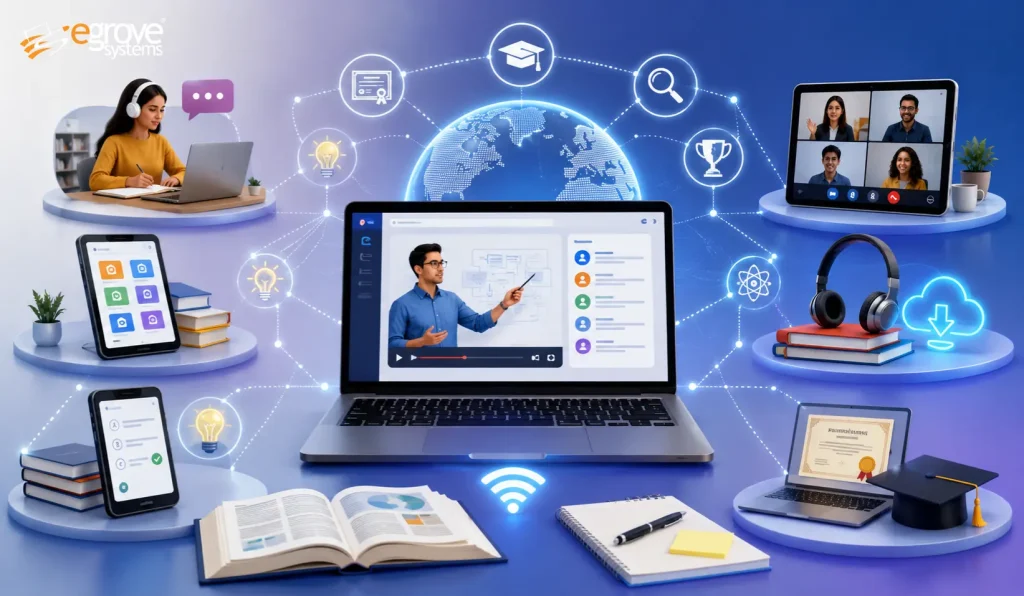
E-learning (Electronic Learning) refers to the process of delivering education, training, or knowledge through digital technologies.
Instead of traditional classroom-based instruction, learners access educational materials online using computers, tablets, or smartphones.
E-learning can include:
- Video lessons
- Interactive modules
- Webinars
- Virtual classrooms
- Assessments
- Mobile learning
- Microlearning
- Gamified learning
- Certification programs
Today, e-learning supports everything from employee onboarding and compliance training to university education and professional certification.
What is a Learning Management System (LMS)?
A Learning Management System (LMS) is software designed to create, organize, deliver, manage, and track learning activities.
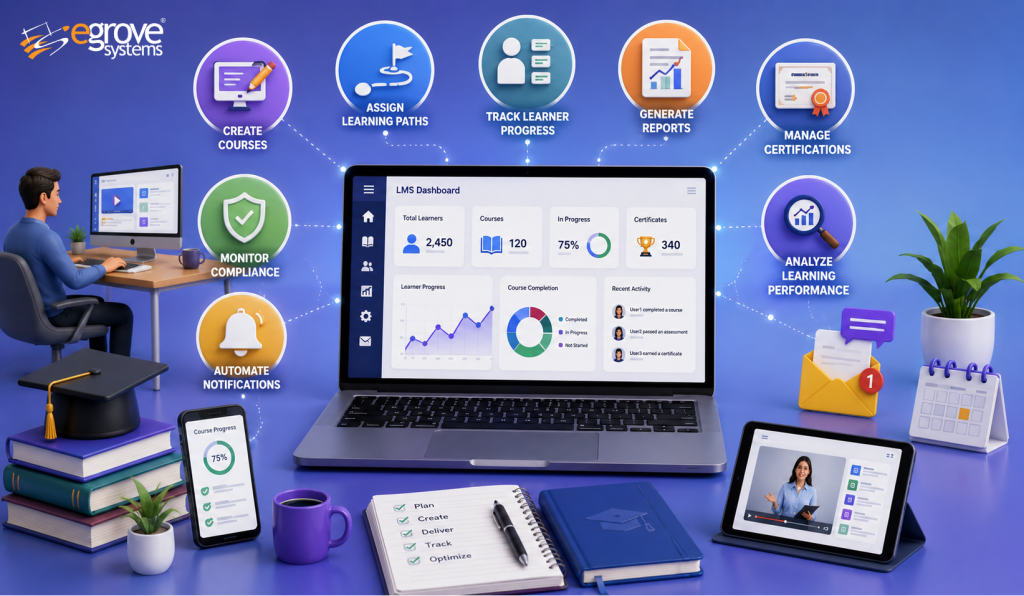
Unlike simple learning websites, an LMS acts as the central hub where administrators can:
- Create courses
- Assign learning paths
- Track learner progress
- Generate reports
- Manage certifications
- Monitor compliance
- Automate notifications
- Analyze learning performance
An LMS focuses on managing the entire learning lifecycle rather than simply hosting educational content.
What is an E-Learning Platform?
An e-learning platform is a broader concept.
It refers to any digital platform that enables online learning experiences.
Examples include:
- Online course marketplaces
- Corporate learning portals
- Virtual classroom software
- Video-based learning websites
- Educational content platforms
Some platforms simply provide learning content, while others include LMS functionality.
Think of an e-learning platform as the overall learning environment, whereas the LMS is the engine responsible for managing learning operations.
LMS vs E-Learning Platform: The Core Difference
| Feature | Learning Management System (LMS) | E-Learning Platform |
| Primary Purpose | Manage learning | Deliver learning |
| Course Management | Yes | Sometimes |
| User Administration | Yes | Limited |
| Progress Tracking | Advanced | Basic or unavailable |
| Compliance Reporting | Yes | Usually limited |
| Certification Management | Yes | Sometimes |
| Analytics & Dashboards | Extensive | Basic |
| Assessment Management | Yes | It depends on the platform. |
| Enterprise Integration | Yes | Limited |
| Best For | Organizations, enterprises, institutions | Individual learners or content delivery |
Why Businesses Need an LMS Instead of Just an E-Learning Platform
Many organizations initially adopt an online learning platform because it is quick and affordable.
However, as teams grow, challenges emerge:
- Difficult learner management
- No centralized reporting
- Compliance gaps
- Manual tracking
- Certification issues
- Inconsistent learning experiences
An enterprise LMS solves these problems by bringing everything together under one system.
It enables organizations to:
- Standardize employee training
- Reduce administrative work
- Improve learner engagement
- Track mandatory certifications
- Maintain audit-ready records
- Deliver personalized learning experiences
Key Features of a Modern Enterprise LMS
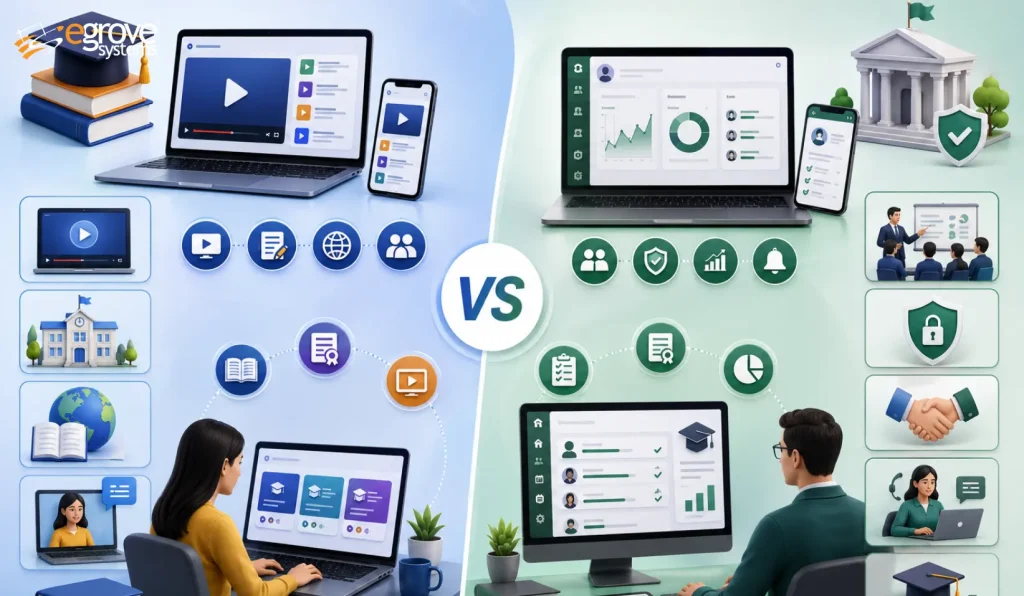
Today’s LMS solutions are far more intelligent than traditional course management software.
1. Centralized Learning Management
A single dashboard manages all courses, users, certifications, reports, and assessments.
This reduces administrative overhead while improving consistency.
2. Personalized Learning Paths
Different employees require different skills.
Modern LMS platforms allow organizations to assign customized learning journeys based on:
- Department
- Role
- Experience level
- Skills
- Certifications
AI is increasingly being used to recommend personalized learning paths and adaptive content.
3. Automated Compliance Training
Industries such as healthcare, finance, manufacturing, and corporate enterprises require mandatory compliance training.
An LMS can automate:
- Course assignments
- Due date reminders
- Certification renewals
- Audit reports
- Compliance dashboards
4. Assessment and Evaluation
Organizations can measure knowledge through:
- Quizzes
- Scenario-based assessments
- Practical assignments
- Simulations
- Final examinations
Detailed analytics help identify skill gaps.
5. Real-Time Analytics
Managers can instantly view:
- Completion rates
- Assessment scores
- Course popularity
- Department performance
- Skill development progress
These insights support better workforce planning.
6. Mobile Learning
Employees expect learning anytime and anywhere.
Modern LMS platforms support:
- Smartphones
- Tablets
- Offline learning
- Responsive design
This flexibility significantly improves participation.
7. Certification Management
After course completion, learners automatically receive certificates.
The system tracks:
- Expiration dates
- Renewal schedules
- Compliance status
This is especially valuable for regulated industries.
Where an E-Learning Platform Works Best
An e-learning platform is an excellent choice when the primary goal is content delivery rather than learning administration.
Ideal scenarios include:
Online Course Businesses
Companies selling educational courses directly to customers.
Educational Websites
Schools providing digital lessons to students.
Public Learning Portals
Organizations offering free learning resources.
Skill Development Platforms
Professional learning communities focused on individual learners.
Where an LMS Works Best
An LMS becomes essential when organizations need structured learning management.
Examples include:
Corporate Training
- Employee onboarding
- Product training
- Leadership development
Compliance Training
- HIPAA
- OSHA
- POSH
- GDPR
- Cybersecurity awareness
Partner Training
Organizations can educate distributors, dealers, and business partners through dedicated learning portals.
Customer Education
Software companies often use LMS platforms to train customers on product usage.
Higher Education
Universities manage:
- Faculty
- Students
- Courses
- Examinations
- Attendance
- Learning analytics
Benefits of Implementing an Enterprise LMS
Organizations adopting a modern LMS typically experience several operational improvements.
Improved Learning Consistency
Every employee receives standardized training regardless of location.
Better Employee Engagement
Interactive content, gamification, quizzes, and personalized learning paths improve participation.
Faster Onboarding
New employees become productive more quickly through structured onboarding programs.
Reduced Administrative Work
Automation eliminates repetitive manual tasks.
Data-Driven Decisions
Managers gain visibility into workforce readiness and skill development.
Scalable Learning
Whether training 50 employees or 50,000, the same LMS infrastructure can scale efficiently.
Common Misconceptions
“Our company already uses an online learning website.”
A learning website is not necessarily an LMS.
Without learner tracking, reporting, certifications, and analytics, organizations still lack centralized learning management.
“Video hosting is enough.”
Videos alone cannot measure:
- Learning effectiveness
- Knowledge retention
- Compliance completion
- Skill improvement
An LMS fills these gaps.
“An LMS is only for schools.”
Modern LMS solutions are widely used across:
- Healthcare
- Manufacturing
- Banking
- IT
- Retail
- Government
- Logistics
- Hospitality
- Corporate enterprises
How AI is Transforming Modern LMS Solutions
Artificial intelligence is rapidly redefining digital learning.
Instead of static course libraries, modern LMS platforms are becoming intelligent learning ecosystems capable of:
- Personalized learning recommendations
- AI-generated assessments
- Automated course creation
- Predictive learner analytics
- Skill-gap identification
- Intelligent content recommendations
- AI-powered virtual learning assistants
Organizations are increasingly shifting from “course delivery” to measurable capability development through AI-powered LMS platforms.
Why Organizations Choose Custom LMS Development
Off-the-shelf solutions may satisfy basic learning requirements, but many organizations require capabilities tailored to their unique business processes.
Custom LMS development enables organizations to:
- Integrate with HRMS, ERP, CRM, or identity management systems
- Support organization-specific workflows
- Build custom reporting dashboards
- Manage role-based learning paths
- Ensure enterprise-grade security
- Scale with future business growth
Custom solutions also offer greater flexibility for branding, compliance, and automation.
How eGrove Systems Helps Organizations Build Smarter Learning Solutions
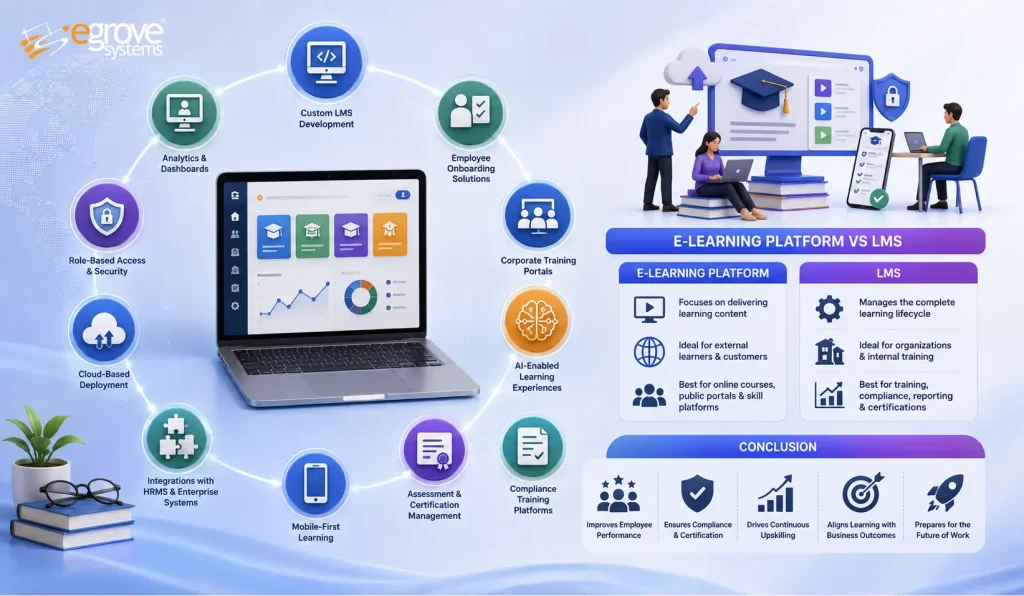
At eGrove Systems, we help organizations design and develop enterprise-grade Learning Management Systems tailored to their business objectives.
Our LMS development expertise includes:
- Custom Learning Management System development
- Corporate training portals
- Employee onboarding solutions
- Compliance training platforms
- AI-enabled learning experiences
- Assessment and certification management
- Mobile-first learning applications
- Cloud-based LMS deployment
- HRMS and enterprise software integration
- Analytics and performance dashboards
- Role-based access and security controls
Whether you’re building a learning ecosystem for employees, partners or customers, our team delivers scalable, secure and future ready LMS solutions that align learning with business outcomes.
Conclusion
While both e-learning platforms and Learning Management Systems support digital education, they serve different purposes.
An e-learning platform focuses on delivering educational content, while an LMS manages the complete learning process from enrollment and course delivery to assessments, reporting, certifications, and analytics.
As organizations continue to prioritize workforce development, compliance and continuous upskilling, investing in a modern LMS provides the structure, automation, and intelligence needed to build a highly capable workforce.
Choosing the right solution today helps organizations stay competitive, improve employee performance and prepare for the future of work.
Current E-Learning & LMS Trends (2026)
The Future of Digital Learning at a Glance
-
AI-powered personalization is becoming a standard feature in modern LMS platforms, delivering adaptive learning paths and real-time recommendations based on learner behavior. (workramp.com)
-
Skills-based learning is replacing traditional completion-focused training, with organizations emphasizing measurable workforce capability and business outcomes. (eLearning Industry)
-
Microlearning continues to drive engagement, with organizations reporting higher productivity and learner participation through short, role-based training modules. (ProProfs Training Maker)
-
Mobile-first learning has become essential as hybrid and remote workforces expect training accessible from any device. (Kaopiz)
-
Learning analytics and predictive reporting are enabling HR and L&D leaders to identify skill gaps, monitor performance, and optimize training investments. (workramp.com)
-
Accessibility and inclusive learning design are now considered core quality standards, ensuring digital learning experiences are usable for diverse workforces and compliant with accessibility guidelines. (eLearning Industry)